
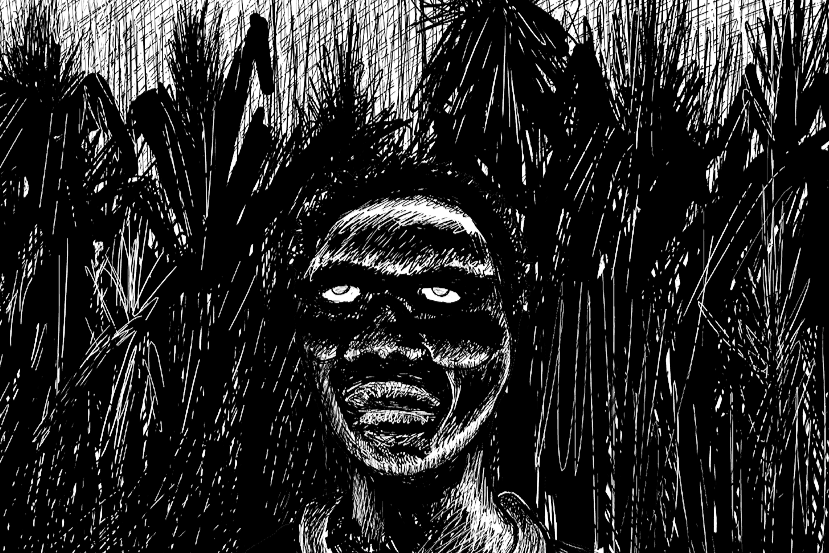
From its Haitian roots to today’s global obsession, the zombie has come a long way. Western culture has come to associate zombies with uncontrollable contagion and viral death. But beneath the familiar image of the flesh-eating undead lies a very different story.
The Haitian zombie is not a creature of viral contagion, but a symbol of social death and the loss of personal freedom. It is a form of ultimate punishment, reserved for the “bad living”.
This article looks at how the original myth evolved, why these creatures keep reflecting the fears and anxieties of the societies that created them, and even how the zombie connects to the vampire.
Zombification in Haitian Culture: A Fate Worse Than Death
In Haitian Vodou, death is an omnipresent reality, and the dead remain connected to their families and communities through rituals and ancestral practices. Here, the zombie does not symbolize resurrection so much as the loss of control over one’s body and will. By becoming a zombie, a person is deprived of their ability to participate normally in society. This image of a powerless person reduced to servitude also resonates with Haiti’s history of slavery and exploitation.
Haitian zombies can take different forms:
The psychiatric zombie: Some people identified as zombies have had a condition linked to mental or neurological disorders, like schizophrenia. These individuals are considered to have visited the realm of the dead and may adopt mystical behaviors.
The social zombie: In times of natural disaster, which frequently strike Haiti, people presumed dead may sometimes be replaced by others with fabricated identities. The family members pretend to recognize the “returned” person as their missing relative, a ritual that helps cope with grief.
The toxic zombie: In the traditional sense, zombification is the ultimate punishment for someone found guilty of serious harm against society. The person is poisoned by a bokor, or Vodou practitioner, placed in a deathlike state, buried, and later revived. They are then kept in a hypnotic state of submission with the help of barbiturates.
This practice, when described as a form of punishment outside conventional justice, mirrors the history of slavery in Haiti, the first Black nation to gain independence in 1804. The zombie embodies the profound horror of enslavement: a reanimated person stripped of autonomy and controlled by another, the ultimate loss of free will.
The Science Behind Zombification
One scientific hypothesis of the toxic zombification phenomenon involves the use of tetrodotoxin (TTX), a powerful neurotoxin extracted from the liver of puffer fish, called “froufrou” in Haiti and “fugu” in Japan. TTX blocks voltage-gated sodium channels in nerve cells, preventing normal nerve and muscle function: heartbeat slows, breathing becomes shallow, and muscles become paralyzed. A person who has been intoxicated may appear dead or profoundly incapacitated while retaining a degree of awareness.
Because TTX does not penetrate human skin, it is often combined with frog saliva or viper venom, which causes local inflammation and itching, prompting the victim to scratch and inadvertently introduce the toxin into their bloodstream.
The Spread of Zombies in America
The Haitian zombie entered American popular culture during the United States occupation of Haiti (1915–1934), when American anthropologists and authors became fascinated with Haitian culture and especialy Vodou, which shares certain beliefs with those present in the United States, particularly in New Orleans.
William Seabrook’s 1929 book The Magic Island played a major role in introducing the Haitian zombie to a mass English-speaking audience. The book presented zombies as dead bodies brought back to a mechanical form of life and forced to work. On the other hand, Victor Halperin’s film White Zombie, released in 1932, stayed closer to the original concept. It features a plantation owner who uses a bokor to turn people into zombies and make them work in his fields, connecting the zombie with forced labor, racial hierarchy, and colonial anxieties.
George Romero’s Night of the Living Dead in 1968 marked a decisive turning point in the evolution of the myth. Romero abandoned the idea of zombies presented as victims of a human master, and replaced it with an expanding mass of cannibalistic, virus-like creatures.
The Modern Zombie Apocalypse
Starting in the 1980s, zombies were reimagined within a global apocalyptic context. This resurrection aligned with the planetary upheavals of the late 20th century, such as globalization, mass consumption, pandemics, climate crises, economic collapses, and the fragility of social order.
The threat was no longer a single sorcerer controlling a few victims but the collapse of society itself. Its most persistent themes are survival, fear of infection and the disappearance of individuality within a larger mass.
The zombie is particularly effective because the threat spreads. Anyone can become infected, and once transformed, the individual becomes part of the threat. The boundary between victim and aggressor disappears.
Zombies vs. Vampires: Reflections of Cultural Anxieties
In western culture, Zombies and vampires are both dehumanized creatures endlessly caught between life and death. In both cases, a person is transformed by Infection through bites. but they embody very different fears.
While the modern zombie involves the threat of mass contagion, with individuals turned into anonymous members of a threatening collective, the vampire vampire is traditionally a solitary and intelligent creature, often associated with seduction, privilege, and aristocracy.
The modern literary vampire emerged in the 19th century, drawing on older European folklore, with the rise of fears associated with the collapse of traditional moral values. This myth also draws on a rise of xenophobia at the time. The vampire is often portrayed as an outsider who enters society from obscure places, frequently associated with Eastern Europe and the exotic Other.
The zombie represents the opposite threat. It is not the powerful outsider but the ordinary person transformed into part of the mass. Anyone can become one, and the threat comes not from an individual predator but from the crowd.
The zombie and vampire myths, side by side:
Contagion vs. Elitism : Zombies represent a universal threat: anyone can become one. Vampires embody a more exclusive transformation, in which the victim is initiated into a separate and often powerful class of beings.
Horde vs. Individual : Zombies attack in groups, symbolizing the fear of the mob. Vampires act alone or in small groups, symbolizing the fear of the individualized Other.
Loss of Self vs. Transformation : The modern zombie loses individuality and agency. The vampire retains intelligence and identity, but physical transformation is accompanied with a corrupt moral.
Conclusion
The evolution of the zombie myth illustrates how monsters change as social anxieties change.
From its origins in Haiti, the fear of slavery and forced labor has made the zombie a powerful symbol of exploitation and the destruction of free will and social existence. In American popular culture, zombies were gradually transformed into the modern image of the undead horde, representing a global fear of viral contagion, social collapse, and the loss of individualism in favour of a society of the mass
Though in distinct ways, both zombies and vampires myth reflect societal anxieties about transformation of individuals through infection. The zombie represents what happens when the individual disappears into the mass; the vampire represents what happens when the individual becomes something powerful and corrupted.
As societal anxieties change, these myths will undoubtedly continue to evolve.
This post is based on the anthropologist Philippe Charlier and his book Zombis, investigation into the living dead (2025), which he wrote in his second office, the cemeteries of Port-au-Prince and Artibonite, where zombies survive.