Costa Rica is small, but its mountains, scattered roads, and sprawling capital make getting around more complicated than expected. After Colombia, some things felt familiar; others did not.
Temperature-wise, I got to keep my lovely Colombian weather—the cool, mountain kind—by settling in the suburbs of San José, at around 1,200 meters above sea level, and even climbing farther up the volcanic slopes around San Isidro de Coronado.
Despite being only about an hour from Medellín by air, the fauna and morning bird chorus are noticeably different. Costa Rica is also much tamer on the bug front. Aside from ants trying to eat your feet if you stand still for too long, I encountered surprisingly few annoying insects—a pleasant change after Brazil and Argentina, where I served as a mosquito buffet for much of my time.
Getting Around: The Long Way Everywhere
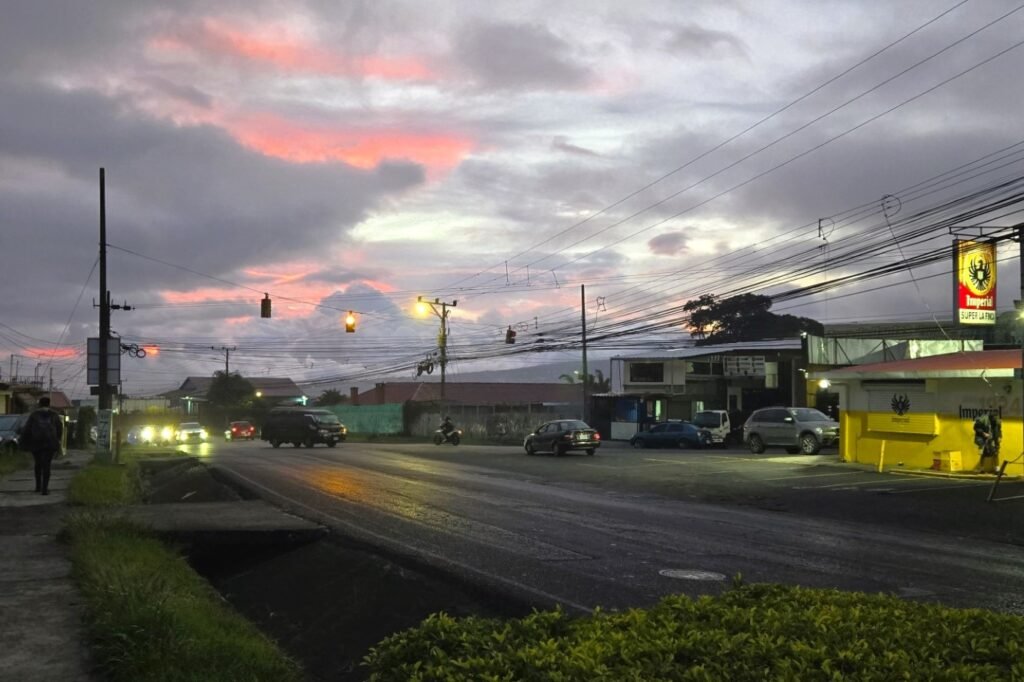
Navigation-wise, Costa Rica is small and almost island-like, with long coastlines surrounding a mountainous center stacked with volcanoes. San José spreads across this terrain like an oil stain, while its road network is patchy and shaped somewhat like a star. If you want to travel from suburb A to suburb B sitting right next to it, you may still have to head all the way back toward the city center.
Add to that a maze of cul-de-sacs and dead ends, and you quickly learn that the fastest route between two points is a zigzag. This might partly explain why everything is so expensive: delivering anything must be a logistical nightmare.
The same pattern extends across much of the country, with San José acting as the central transport hub. Going from one region to another often means passing through the capital, even when it looks completely unnecessary on a map.
Outside the city, most roads seem designed for cars first and everyone else second. Sidewalks are inconsistent, and bike lanes are rare. Between speeding drivers and impatient truckers, walking or cycling along major roads can feel like asking for trouble. By comparison, I found Cuba much friendlier to slow travelers.
Safety: Not So Different From Colombia
In terms of safety, Costa Rica felt fairly similar to Colombia. Central San José could feel sketchy at night, particularly when I had to walk between bus terminals located away from the busier parts of the city.
Once out in the suburbs, however, the atmosphere changed completely. I found them quiet and secure, and I felt comfortable traveling by public bus, even late in the evening.
For all its reputation as an easygoing tropical paradise, Costa Rica still requires some basic urban awareness. But in my experience, getting around safely was less of a challenge than figuring out how to get from A to B without going through C.